


Turning Operational Challenges into Business Value
Tech-Clarity surveyed 298 companies about what it takes to achieve a competitive advantage in product development. The survey identified three top drivers of that advantage: product quality, innovation, and speed to market. However, achieving these outcomes requires overcoming various product development challenges, which are explored below.
Inefficiencies Lead to Product Development Delays
In the survey, well over half of respondents cited late-stage design changes as the most common reason for missing product development dates. Other reasons include:
- Wasting time on non-value-added tasks
- Working with outdated information
- Rework due to incorrect bill of materials
- Waiting for data from suppliers
- Validating regulatory compliance
All of these take time away from design work and meeting product delivery dates.
Identifying Sources of Wasted Time
Looking more closely at the non-value-added tasks that consume engineers’ time, Tech-Clarity found several sources. The research shows that engineers lose significant time doing non-value-added work: fixing errors caused by incorrect data, searching for information, and collaborating inefficiently.
CAD data presents unique challenges that lead to inefficiency, including:
- Hard or slow to find data
- Broken file associations
- Sharing data
- Hard to manage and share multi-CAD formats
Collaboration Across Teams is Hard
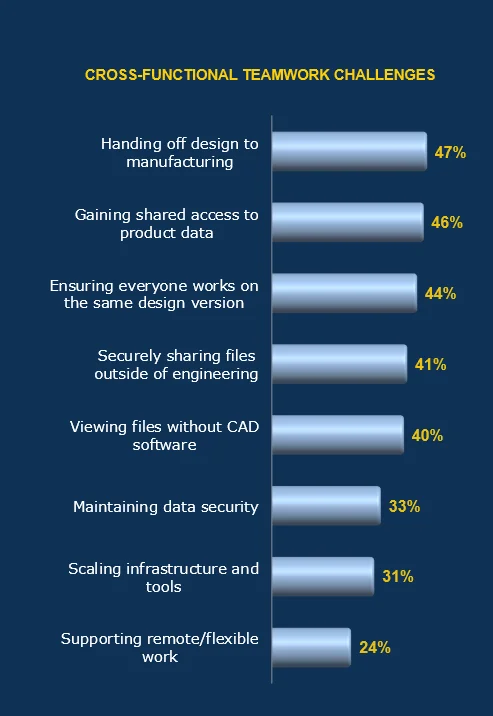
Manufacturers most commonly cite the handoff between engineering and manufacturing as a cross-functional challenge, underscoring the importance of collaboration between these groups. Many manufacturers report difficulty providing secure access to product data for those outside engineering. Infrastructure scalability and support for remote workers also contribute to collaboration challenges.
Ineffective Project Management
Nearly half of the manufacturers report project management challenges, including:
- Poor visibility into team status and progress
- Lack of real-time project status
Many report poorly managed task dependencies and poor risk identification and management as issues. Part of the project management challenge may come down to how the projects are managed. Most rely on standalone project management tools that operate independently of engineering systems.
New Product Development Challenges Impact Business
New product development challenges directly affect business performance, including revenue, profitability, and competitiveness. Due to these challenges, the companies in the survey report:
- Missed launch dates
- Higher development and product costs
- Less time to iterate and innovate
- Product quality issues
Individually or together, these findings show that product development challenges are not isolated operational issues; they directly affect business performance.
PLM Drives NPD Performance
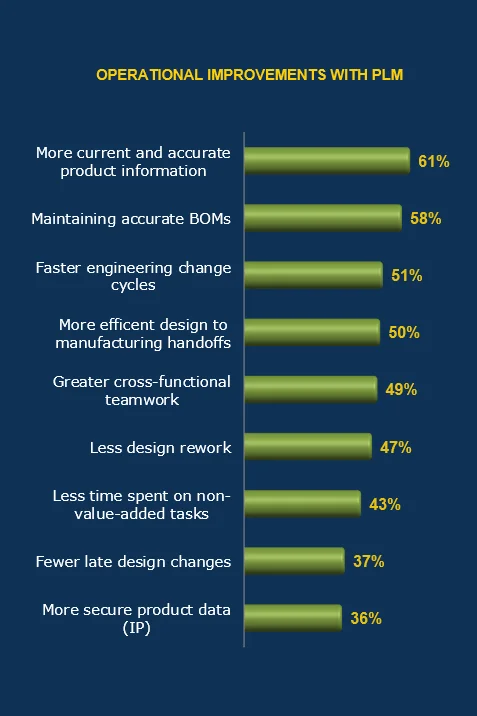
The survey results show that PLM delivers improvements that closely align with the challenges manufacturers identified, evidence that PLM can play a significant role in addressing them and improving business performance.
Many respondents report improvements in the process areas that drive engineering productivity, including:
- More current and accurate product data
- Maintaining accurate BOMs
- Faster engineering change cycles
Efficient manufacturing handoffs and better security were also cited. The findings show that PLM’s value goes beyond better data management.
PLM Delivers Business Value
The operational improvements above lead to business benefits. When PLM removes inefficiencies:
- Development moves faster
- Quality and innovation improve
- Product development costs and compliance risks decline
These findings reinforce that PLM is not simply an operational tool, but a strategic business platform. PLM helps organizations improve competitiveness, profitability, and long-term performance.
Cloud-based PLM Brings Additional Benefits
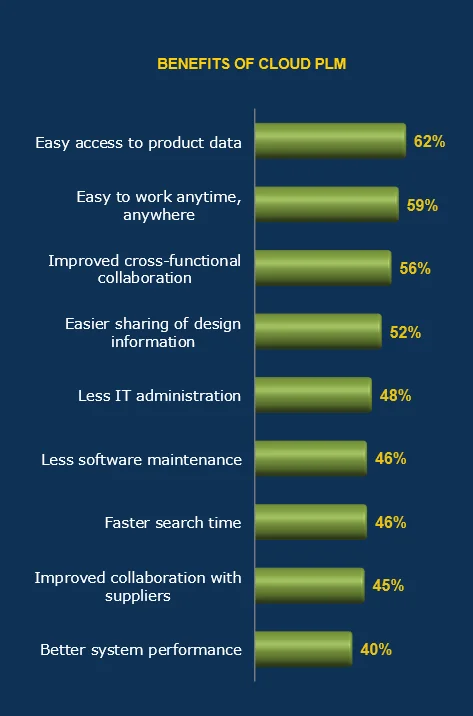
In addition to the benefits above, manufacturers using Cloud PLM report:
- Easier access to product data
- The ability to work anytime from virtually anywhere
- Improved cross-functional collaboration
- Better collaboration with suppliers
- Less IT administration and software maintenance
Integrated Project Management Improves On-Time Delivery
Manufacturers who connect project management directly to their product data also report meaningful improvement in on-time delivery. The results indicate that an integrated project management solution can be a valuable tool for accelerating new product development.
Top Performers Have More Mature Data Management
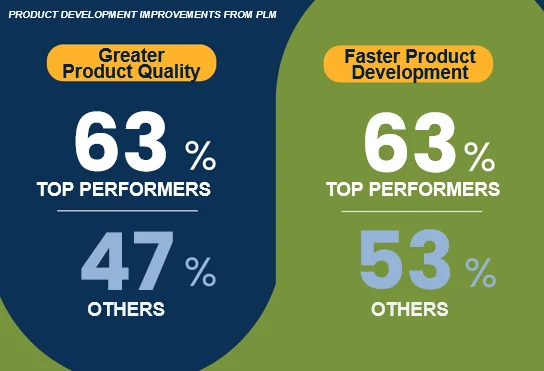
The research suggests that Top Performers, companies that excel at developing products across time to market, quality, innovation, and compliance, distinguish themselves primarily by integrating PLM with data management, rather than by running both as standalone systems.
This integration advantage carries over into how design data is shared outside engineering, with Top Performers more likely to share through PLM and rely much less on ERP or ad hoc methods such as shared network drives.
Top Performers Streamline Processes Across NPD
While EBOM management in PLM is common practice, Top Performers are more likely to manage MBOMs in PLM. Top Performers also streamline related processes:
- Use digital workflows for change management
- Maintain comprehensive raw material data in BOMs
- Readily tracing product design history
All of these point to the broader value of a connected digital thread spanning engineering and manufacturing.
How to Gain a Competitive Edge with PLM
Addressing product development challenges is not something manufacturers should put off. Inefficiencies in product development undermine the ability to gain a competitive edge. The longer these issues go unaddressed, the more business performance may suffer.
The findings suggest manufacturers should:
- Implement PLM with integrated data management, rather than treating the two as separate systems
- Consider Cloud PLM, particularly for manufacturers concerned about cost or limited IT resources
- Extend PLM and data access to people outside engineering
- Manage both engineering and manufacturing bills of materials in PLM
- Consider a purpose-built project management solution
About the Research
This is an Executive Summary of a Tech-Clarity research report, Achieving a Competitive Edge in New Product Development. You can access the report with the complete research findings here.
About the Author
Howie Markson is the Director of Research for Digital Innovation at Tech-Clarity, where he leads research on digital innovation across product design, simulation, PLM, PDM, AI, and other product development solutions for manufacturing and industrial companies. Howie enjoys engaging with other industry leaders, manufacturers, and technology users to share, in practical ways, the value of digital transformation in improving business performance.
About Tech-Clarity
Tech-Clarity is an independent research firm dedicated to making the business value of technology clear, helping industrial companies learn how to improve performance through digital transformation. You can read the full Tech-Clarity research report, Achieving a Competitive Edge in New Product Development here.