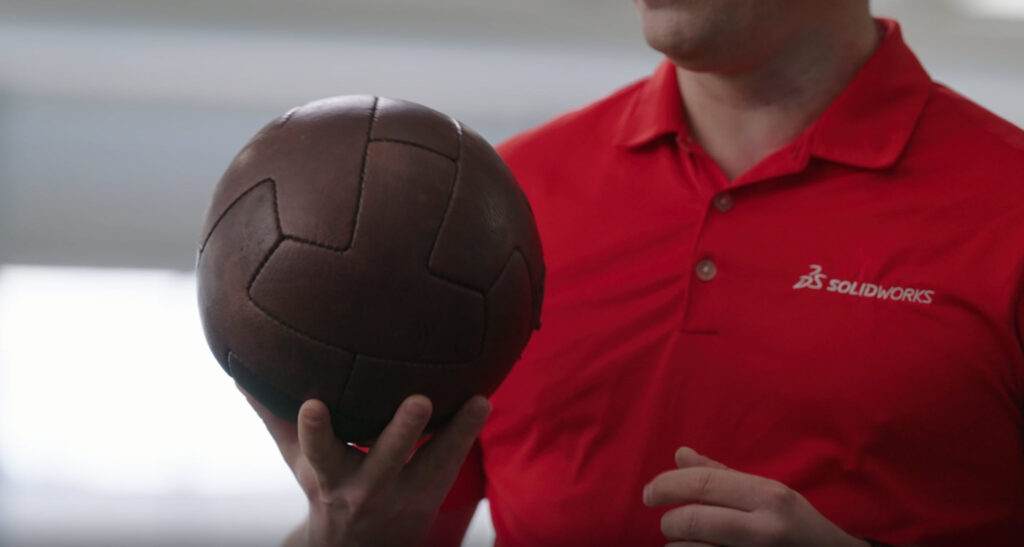

Football (or soccer in North America) is arguably the world’s biggest sport, with over 4 billion fans worldwide. And it has been that popular for a while. Sports where people kick things with their feet have existed for millennia. From the Mayans and Aztecs in 1400 BCE to the Chinese game cuju in 200 BCE, to Europe and beyond in the Middle Ages, the sport we now know of as football has always been global.
The first truly global football tournament took place in 1930. Thirteen international teams gathered in Montevideo, Uruguay, for the inaugural FIFA World Cup. Today, the World Cup has over 200 countries competing for a spot in the tournament.
Since 1930, many have changed in the sport. Rules, uniforms, fan culture, and more. But the most profound changes have been to the equipment; specifically, the football itself. The match football has transformed from a water-absorbing leather sphere into a highly engineered polyurethane truncated icosahedron. Understanding how these material changes affect the ball’s performance required advanced testing. We at SOLIDWORKS were interested in seeing the real differences between the ball from the first World Cup and the ball used in 2026. So we used finite element analysis (FEA) software in our SOLIDWORKS simulation portfolio to see what makes today’s ball superior to the original match ball.
The Evolution of the Football
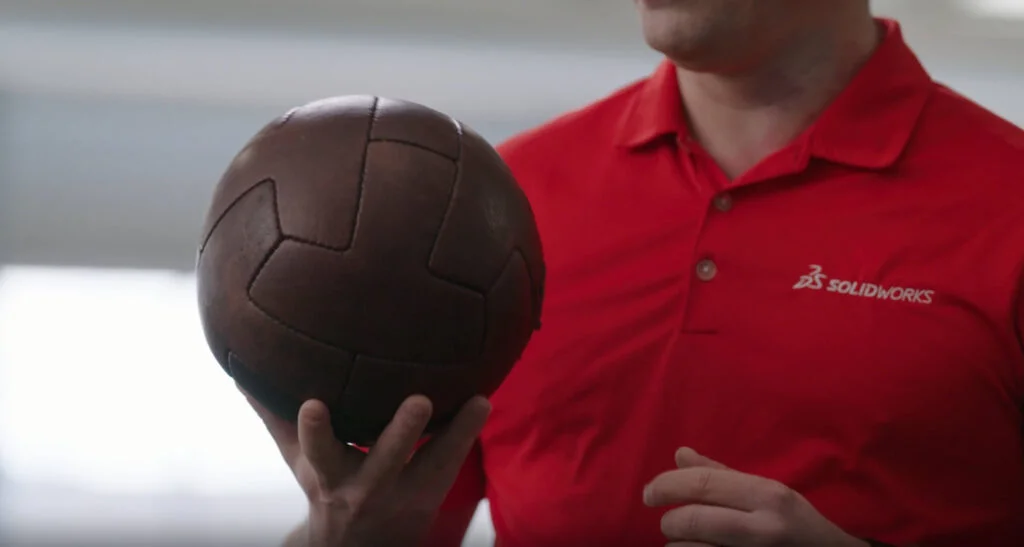
During the 1930 tournament, players kicked a rubber bladder covered in thick leather strips. The heavy stitching made heading the ball painful. And the ball got even heavier when it was wet. When it rained or teams played on a wet field, the leather soaked up water, gained nearly 50% more weight, and became difficult to kick and maneuver. Not only that, the hand-stitched balls often deflated during play, leading to time loss and even less efficient kicking.
Today, the official tournament ball features four thermally bonded polyurethane panels. They are entirely waterproof and include added surface texture for better grip on dry or wet pitches. These advancements represent a massive leap in material science, structural integrity, and product reliability.
Setting Up the Structural Simulation Studies
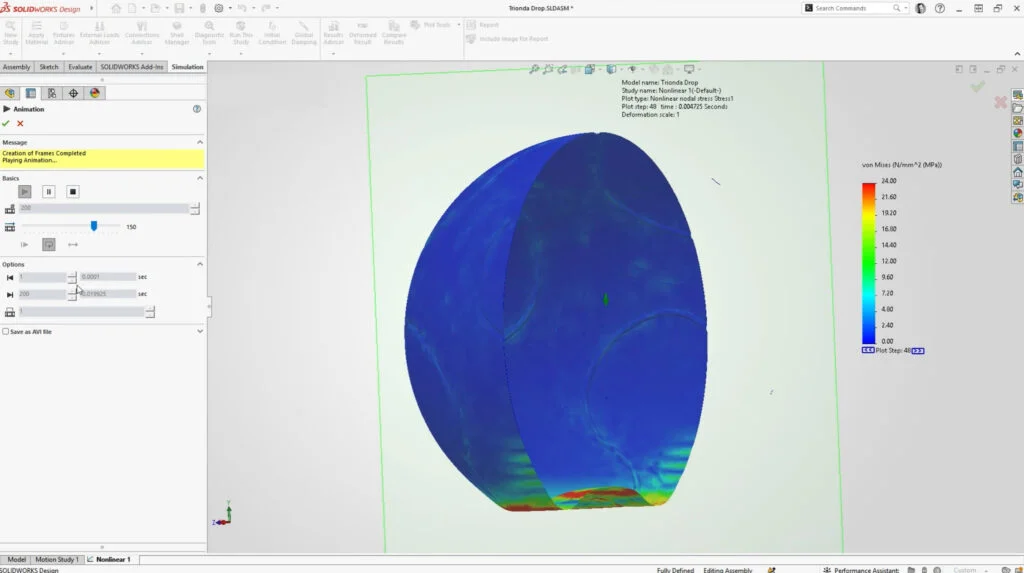
To understand how different materials perform during a kick, we had to measure how much energy the ball returned upon impact. A stiff ball returns efficient energy. A soft ball absorbs it, making it more difficult to manipulate.
To start our investigation, we used SOLIDWORKS Simulation. SOLIDWORKS Simulation enabled our engineers to set up a nonlinear dynamic analysis comparing a modern polyurethane ball, a dry 1930s leather ball, and a wet 1930s leather ball. We modeled each ball as a pressurized shell. Next, we simulated a kick by dropping a rigid plate from 1 meter at an impact velocity of 4.43 m/s. This virtual environment embedded in the SOLIDWORKS Design UI allowed us to test structural responses without setting foot onto a pitch.
Analyzing the Results
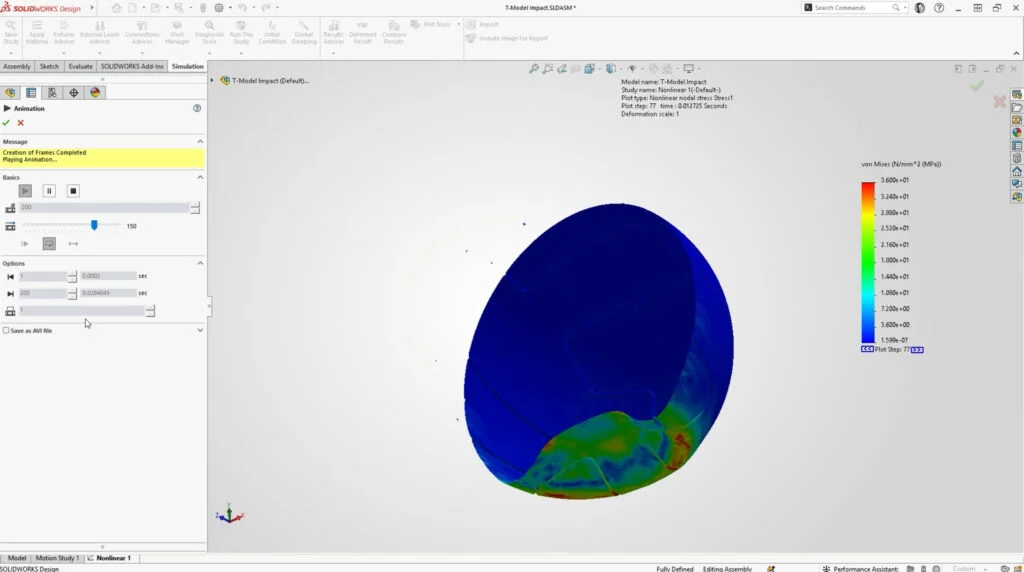
The simulation results clearly demonstrated why modern footballs perform better. When the rigid plate struck the modern polyurethane ball, the stress concentrated cleanly at the impact zone and distributed predictably through the shell. The ball compressed and stabilized quickly. The dry leather ball from the 1930s showed a similar structural response, holding its stiffness effectively under load.
Everything changed, however, when we added water. When simulating a wet leather ball, we found that the waterlogged shell became up to five times less stiff than its dry counterpart. The contact zone spread out drastically, and the ball yielded to the impact. Because the softened shell dissipated the kick’s energy instead of storing it, the wet ball took much longer to recover its shape. For players in the past, this meant gameplay could slow down significantly in the rain. They had to kick a structurally compromised object that resisted their physical effort.
Expanding Computing Power
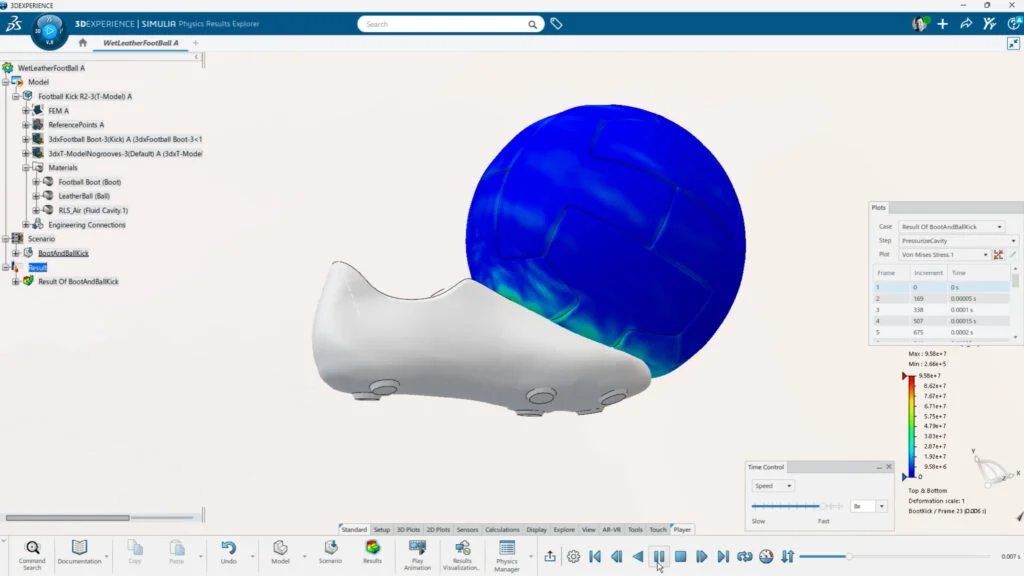
After experimenting with the drop test in SOLIDWORKS Simulation, we wanted to dig deeper. This is common for designers and engineers today; as testing requirements grow more demanding, engineers require high-performance computing to complete full product verification. To do this, we ran the simulation on the cloud-based 3DEXPERIENCE platform, leveraging its enhanced computational capabilities.
With SOLIDWORKS Simulation Analyst, which utilizes advanced meshing techniques and explicit solvers from Abaqus, we were able to test and analyze the aftermath of a kick and see exactly how the wet leather ball deformed. This further verified our findings from SOLIDWORKS Simulation on the desktop, making us that much more confident. Moving from a basic design analysis to comprehensive simulation and product verification ensures that every product iteration meets strict performance standards. And performance is the name of the game in football.
Engineering the Future of Sports
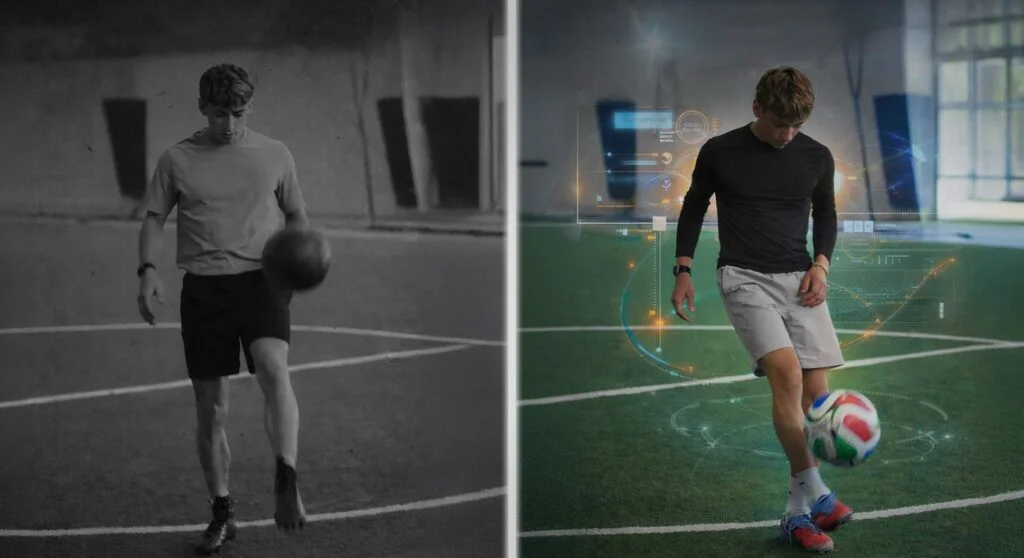
Simulation at every level allows engineers and designers to design with absolute confidence. Through this fun experiment, we were able to understand the history and evolution of the football (or, again, the soccer ball in North America). Analyzing the history of football proves that better materials create faster, more consistent, and safer sporting events. Virtual testing environments help teams identify weaknesses, iterate on designs, and solve structural problems before a physical prototype exists.
Simulation helps us understand the world and the products we make. And as the world gears up for the big international football tournament, we can’t wait to share more simulation stories with you.
