
The Core Challenges of Decentralized Change Processes
Modern engineering environments frequently struggle with siloed information and fragmented data models. Research and industry observations indicate that many organizations still rely on legacy tools such as spreadsheets or disparate PDM systems, leading to a myopic view of business processes. Key statistics and challenges include:
- Communication Gaps: A historical lack of end-to-end visibility where stakeholders only understand their immediate upstream and downstream tasks. This often leads to process breakdowns across departments.
- Weak Version Control: The absence of a “single version of truth,” leading to inconsistent data across design and production. This fragmentation of CAD and supporting data across disparate systems makes it difficult to get a relevant picture of engineering problems.
- Regulatory Compliance: The critical need for auditable trails in high-stakes industries such as medical, aerospace, military contracting, and automotive to ensure all workflows follow a compliant path.
Structural Roles and Governance in Change Execution
SOLIDWORKS portfolio utilizes an ENOVIA role-based architecture to manage technical modifications. The system is bifurcated into two primary operational layers:
- Change Execution: Managed under the Collaborative Industry Innovator role, which is part of SOLIDWORKS Design, allowing for the creation and viewing of Change Actions (CA) and investigative requests. This layer handles the fundamental execution of engineering corrections.
- Change Governance: Managed by the Change Manager role, part of SOLIDWORKS PLM, providing a higher level of orchestration through Change Orders (CO) for multidisciplinary changes affecting multiple departments concurrently.
Workflow I – The Ungoverned Change Action (CA)
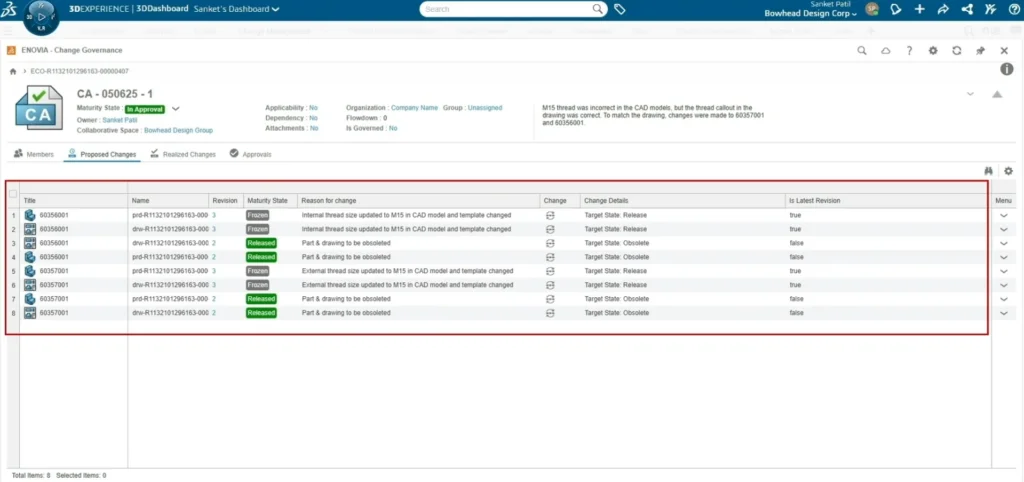
For standalone, low-complexity modifications such as drawing tolerances or minor part updates, an ungoverned CA workflow is utilized. A practical application of this involves CAD-only changes where physical parts are unaffected, such as correcting a derailleur hanger thread and pitch callout that were modeled incorrectly but manufactured correctly per the drawing.
- Technical Implementation: Initiated via the Change Execution app, defining the “what, when, and how” of the severity. Stakeholders are added as informed users to ensure searchability and visibility.
- Maturity Management: Focuses on maturity state changes (e.g., Release to Obsolete) and manual revisioning of parts and drawing templates.
- Validation Protocols: Employs Professional Work Product (PWP) authentication and validation, requiring digital stamps from responsible engineers to ensure compliance with approved quality processes. This satisfies stringent engineering regulatory requirements.
Workflow II – The Orchestrated Change Order (CO)
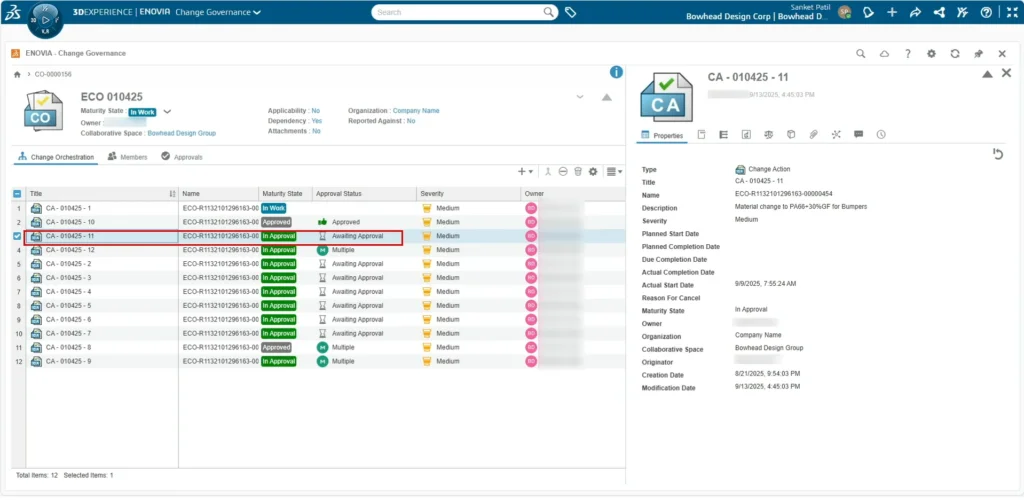
When changes involve extensive stakeholders and inter-departmental dependencies, a Change Order acts as a governing container for multiple related Change Actions. For example, a production run update might involve resolving composite part fits, updating machined components, and changing a plastic bumper material from Polypropylene plus 15% glass to Nylon plus 30% glass to improve thickness and durability.
- The Change Coordinator Role: A central figure responsible for pushing the change forward and ensuring all action items are implemented across the floor, coordinating with vendors, engineering, production, and purchasing.
- Sequential Dependencies: Enables the creation of dependencies between part-level changes and assembly-level changes. For instance, completing part changes first allows 20-30 days for vendor fulfillment before updating assembly drawings and training the production floor.
- Implementation Tracking: Distinguishes between “System Completion” and “Floor Implementation” through the use of Collaborative Tasks. Tasks such as quarantining previous revisions until existing parts are consumed are tracked meticulously before a change is marked as fully implemented.
Workflow III – Formal Change Requests (CR) and Impact Analysis
For modifications involving significant financial investment or tooling changes—such as widening a groove on a carbon composite trim tool to reduce assembly time—a formal Change Request is required to drive decision-making.
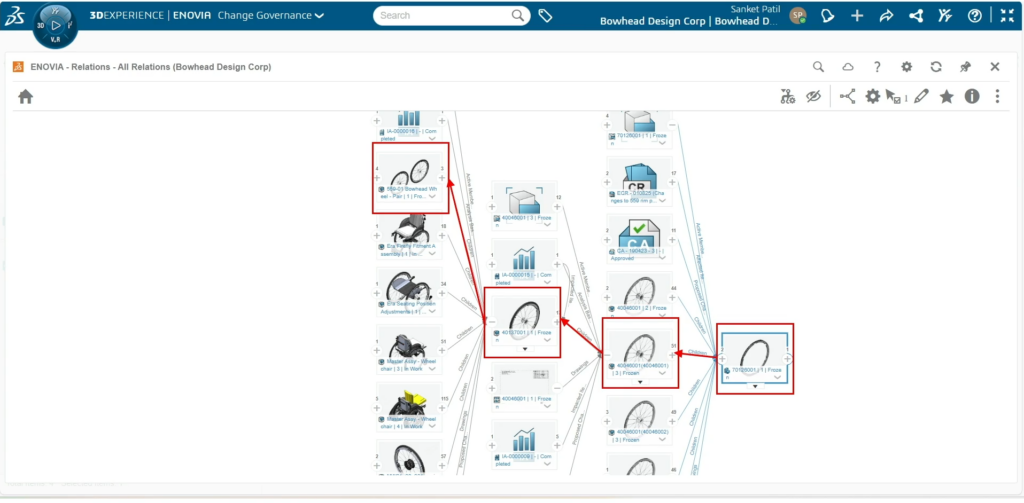
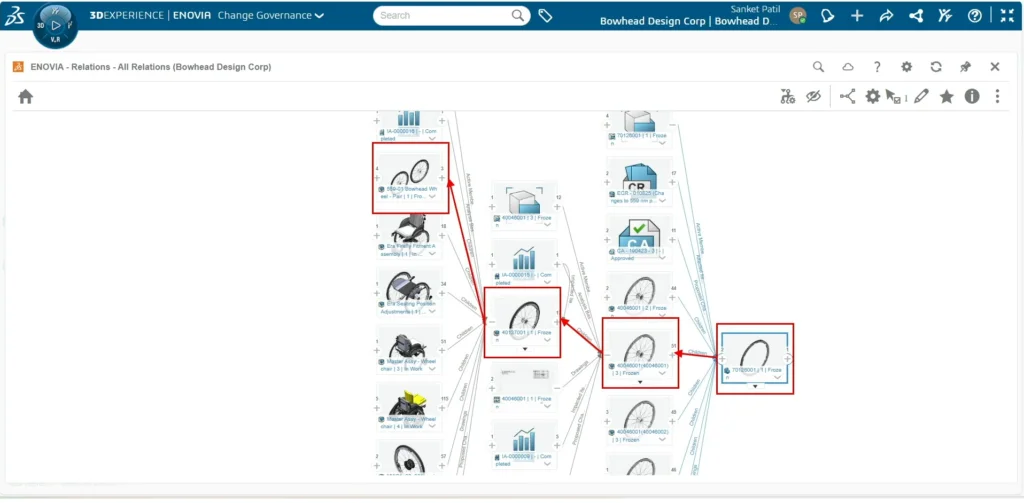
- Impact Analysis: Utilizing the Relations App to identify every affected assembly and Stock Keeping Unit (SKU) within the product structure. This traces the impact from a single component up to the final sellable unit.
- Frozen Structures: Once a CR is approved, the orchestrated structure of CAs and COs becomes frozen to maintain traceability and documentation integrity. Any structural edits require moving the request back to an “in work” state.
Workflow IV – Issue Management and Deviation Tracking
The final layer of change management involves capturing real-world failures and production deviations.
- Deviation Templates: Used by shop floor personnel to request temporary departures from the established Bill of Materials (BOM), such as substituting an equivalent fastener when the specified one is missing.
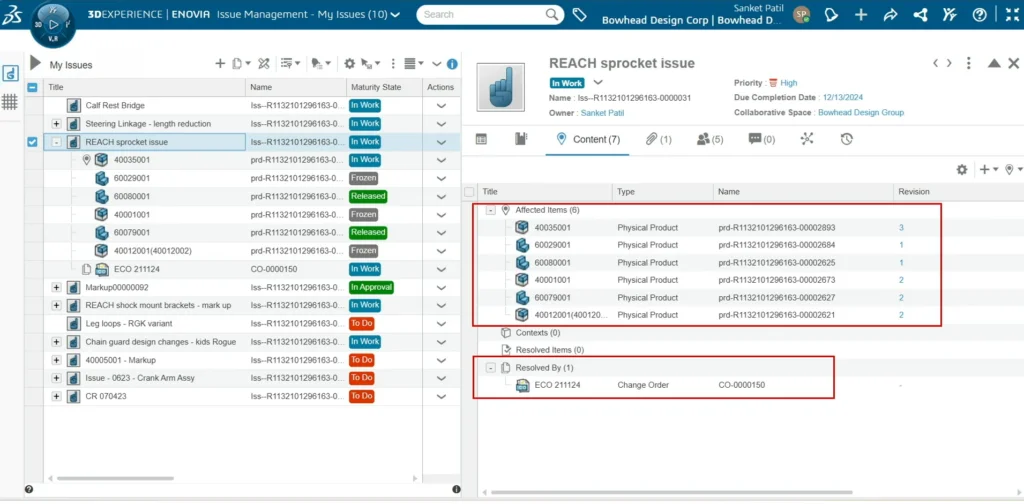
- Issue Integration: Customer service reports or field failures are captured via the Issue Management app and linked directly to the “Resolved By” attribute of a Change Action. A notable example involves an input sprocket failure due to poor vendor quality and long lead times. Sourcing a new North American vendor required replacing a 14-tooth sprocket with a 16-tooth sprocket, which subsequently drove a full change workflow for the transmission assembly to account for new gear ratios.
- Traceability: Provides real-time visibility for the issue originator, tracking the resolution from initial report to engineering fix and final implementation, fully integrating field data into the engineering lifecycle.
Watch this recording to learn more and to see a real-world change workflow implemented at Bowhead Corporation, a manufacturer of adaptive mountain bikes and wheelchairs.
Watch more on-demand sessions from 3DEXPERIENCE World 2026 here: https://www.solidworks.com/community/best-of-3dexperience-world-2026