
Football, or soccer in North America, is defined by nonstop action, split-second decisions, high-level strategy, and global accessibility. As long as you have the right type of ball, anyone can play football. But not everyone can manipulate the football like professional football players. And professional football players, whether they know it or not, are also manipulating physics.
We asked collegiate soccer player Ryan Linhares how he makes a ball curve in the air. “I focus on hitting the ball on the outside with the inside of my foot and finishing with my foot high,” he said. Ryan has been playing football since he was a kid and has many years of practice. He, like the professional football players in the World Cup, is an expert at making the ball move and bend, all while simultaneously running and making a million other decisions.
But while he may know how to physically manipulate the ball with his foot, what about the physics behind the kick? How exactly does that ball curve in the air, or does the air curve around the ball, after it’s kicked? We at SOLIDWORKS decided to investigate.
Visualizing Football Aerodynamics with Computational Fluid Dynamics Tools
Fun fact: air is technically a fluid. And the way you measure air velocity and the pressure around complex shapes is with computational fluid dynamics (CFD) simulation tools. For that, SOLIDWORKS Flow Simulation is the designer and engineer’s choice for virtually testing products and fluid flow.
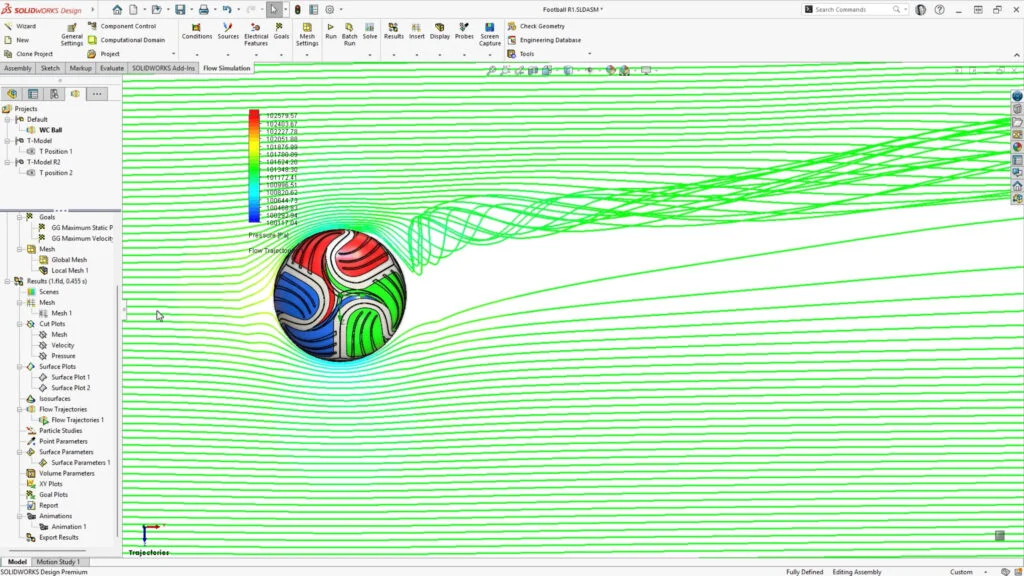
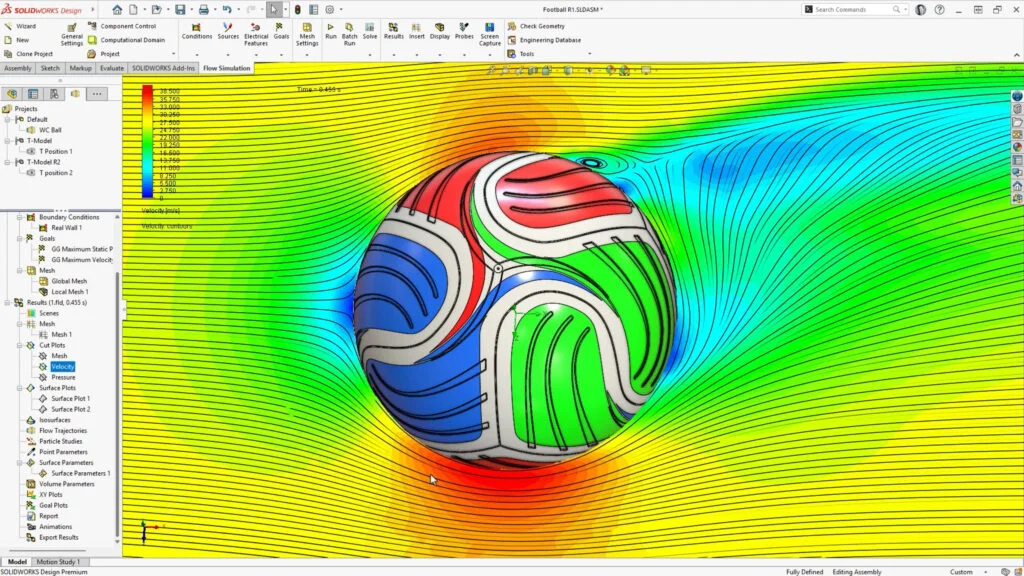
We started with a model of the match ball used in the 2026 international soccer tournament. Since the airflow around the ball will change as it moves, we set up a time-dependent study. Then we included a rotating region, set the fluid to air, and made the kick velocity 27.5 meters per second — the speed of a professional free kick. After further defining the rotation to 450 RPM, roughly what elite players generate at the point of contact, we locked in the calculation goals: velocity and pressure. Then we meshed the domain to capture every shift in flow and gradient across the ball’s surface.
SOLIDWORKS Flow Simulation calculated the velocity as the ball rotated in flight. It showed the air moving faster on one side of the spinning ball and slower on the opposite side. This difference in air speed created a pressure imbalance, a perpendicular force. This force creates the Magnus Effect. This precise aerodynamic phenomenon is what pushes the ball sideways and produces the iconic curve or bend that football fans love to see.
How Ball Design Impacts Flight Path
Equipment design heavily influences these aerodynamic forces. While today’s match ball has been engineered for optimal performance, the ball played in the first-ever World Cup in 1930 was very different.
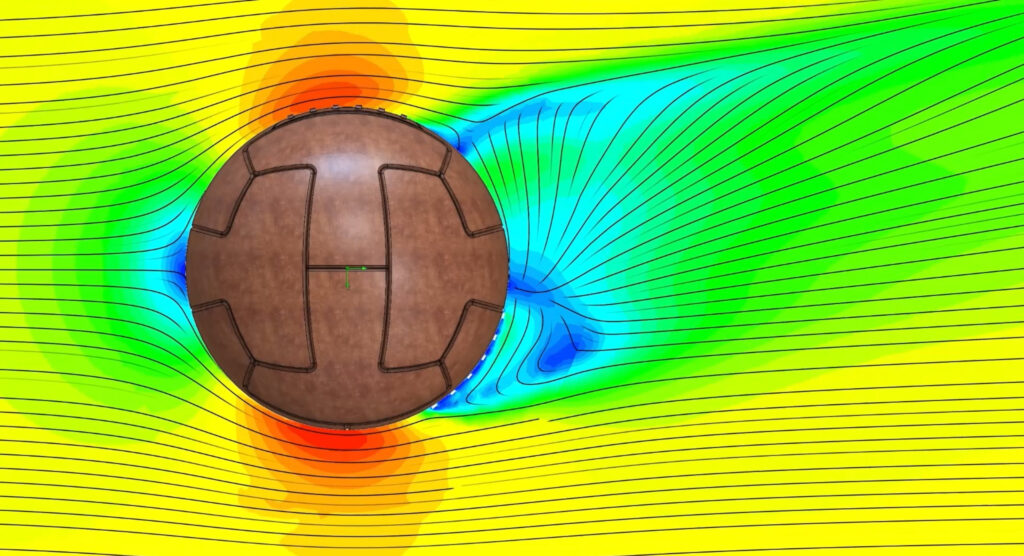
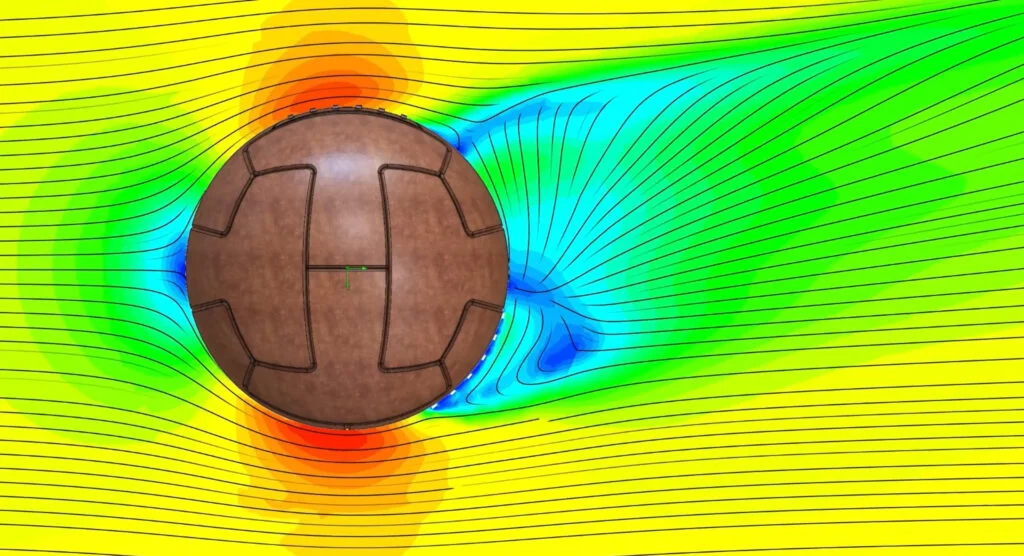
The 2026 match ball is made of polyurethane and has four thermally sealed panels, built for smooth aerodynamics. The ball from 1930 was built to be kicked with the materials they had at the time: leather and laces. Analyzing a match ball from 1930 revealed significant aerodynamic instability. After running the same simulation on a model of the older ball, we found that the laces holding the ball together triggered vortex shedding, which created erratic flight patterns. The rough and irregular surface of the old football created a very turbulent boundary layer which made the football harder to control.
After almost a century of ball improvements, the modern ball unsurprisingly performed much more predictably. SOLIDWORKS Flow Simulation calculated that the modern design produces a steady lateral force of about 4.5 newtons. For players taking it to the pitch in this year’s tournament, that consistent force will generate a smooth and reliable curve, giving players precise control over their shots.
Engineering Better Performance with SOLIDWORKS Flow Simulation
CFD doesn’t have to be scary or complex. It can be used to explain the forces we interact with daily in the real world, and that drive our favorite sports and hobbies. CFD can also be used to optimize our products. The World Cup match ball would not be what it is today if the engineers designing it didn’t use simulation (once simulation software became available—it wasn’t around in 1930).
SOLIDWORKS Flow Simulation equips engineers and designers with an intuitive tool, directly integrated into their CAD solution, for analyzing and optimizing designs across any field. No matter what products you develop, accurate simulation data can help you drive innovation and ensure competitive success — on or off the pitch.