
Introduction: The Manager’s Reality
A manager’s day rarely goes exactly as planned.
The calendar may show a project review, a design discussion, a customer meeting, and travel for a supplier visit. But in reality, the day is shaped by urgent approvals, design issues, team dependencies, customer concerns, and business decisions.
A designer may need approval to move forward. A simulation engineer may flag a performance concern. Manufacturing may identify a producibility issue. A customer may escalate a problem. An executive may ask for a project update while the manager is already on the way to the airport.
In a disconnected environment, this creates chaos. Information is spread across emails, spreadsheets, local files, meetings, and presentations. By the time the manager gets an update, it may already be outdated.
The 3DEXPERIENCE platform changes this experience. It gives the manager one connected environment to understand project status, manage people, review designs, respond to issues, control changes, and make decisions from anywhere.
This is not only a vision. Companies are already seeing the impact. Migma Packtron, for example, used SOLIDWORKS and the 3DEXPERIENCE platform to improve collaboration and data management across product development and manufacturing, cutting design cycles by 30 percent and reducing time-to-market by 20 percent. (SOLIDWORKS)
1. Morning Pulse: Starting with Visibility
The manager starts the day not with email, but with the 3DEXPERIENCE dashboard.
In a few minutes, they can see active projects, open tasks, delayed actions, pending approvals, design maturity, issues, and key project indicators. One project is on track. Another needs attention. A change request is waiting. A simulation result has been posted overnight.
This is more than a status view. It is the decision context.
The manager can quickly see what needs action, who owns it, and whether it affects a milestone. Instead of spending the first hour collecting updates, they begin the day by identifying priorities.
This mirrors the value reported by Migma Packtron, whose director, Nitin Raut, said that the combination of SOLIDWORKS and the 3DEXPERIENCE platform enables teams to “plan, execute, and monitor project status in real time.” The same story highlights how teams can share tasks, define deliverables, manage dependencies, and track key milestones from anywhere. (SOLIDWORKS)
The dashboard becomes the manager’s morning control center, helping them move from reactive firefighting to proactive leadership.
2. Managing the Team: From Status Chasing to Alignment
The engineering team is working across multiple activities. Designers are updating models, simulation engineers are validating performance, manufacturing is reviewing producibility, and quality is checking documentation.
In a traditional workflow, the manager would need a long status meeting to understand what is happening. On the 3DEXPERIENCE Platform, task ownership, due dates, progress, dependencies, and deliverables are already visible.
This changes the purpose of the team meeting.
Instead of asking, “Where are we?” the manager can focus on priorities:
“The bracket redesign is complete, but simulation validation is still open. Let’s prioritize that today because it affects the design review. Manufacturing can review the updated geometry once simulation confirms the load case.”
The team leaves with a clear direction. The manager spends less time chasing status and more time removing blockers.
Dexai Robotics experienced this type of collaboration benefit as it grew its product development team. The company added roles from the 3DEXPERIENCE platform for collaboration, PDM, and PLM capabilities to its SOLIDWORKS environment, increasing design visibility, optimizing design time, and supporting growth from R&D into multiple restaurant placements. (SOLIDWORKS)
3. Design Review: Making Decisions with Product Context
By mid-morning, the manager joins a design review.
This is where technical decisions and business impact meet. Designers care about performance. Manufacturing cares about producibility. Quality cares about compliance. Simulation cares about validation. The manager must balance all of these perspectives.
Without a connected platform, the review may depend on screenshots, emails, separate files, and meeting notes. The team may not even be sure they are looking at the latest version.
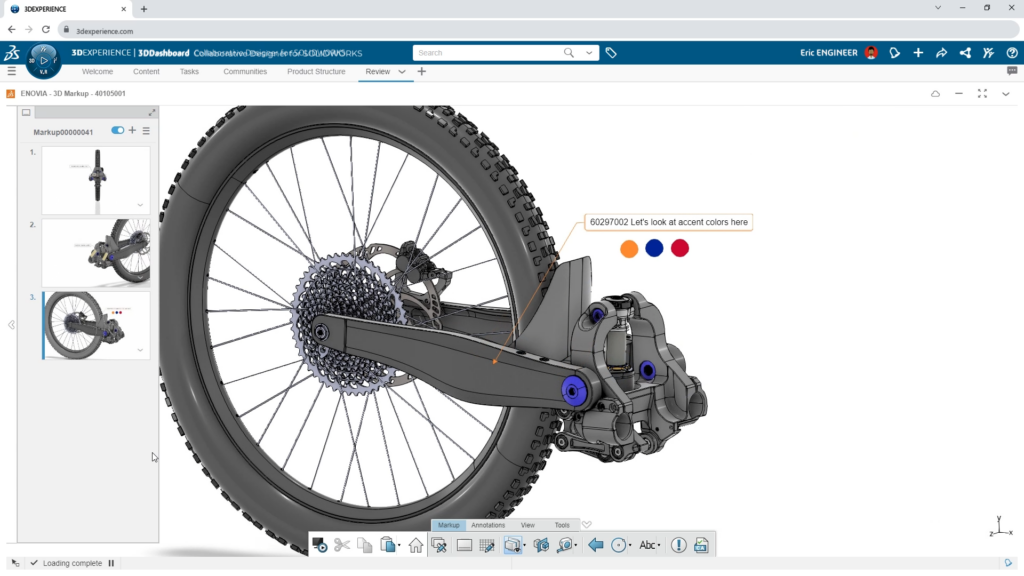
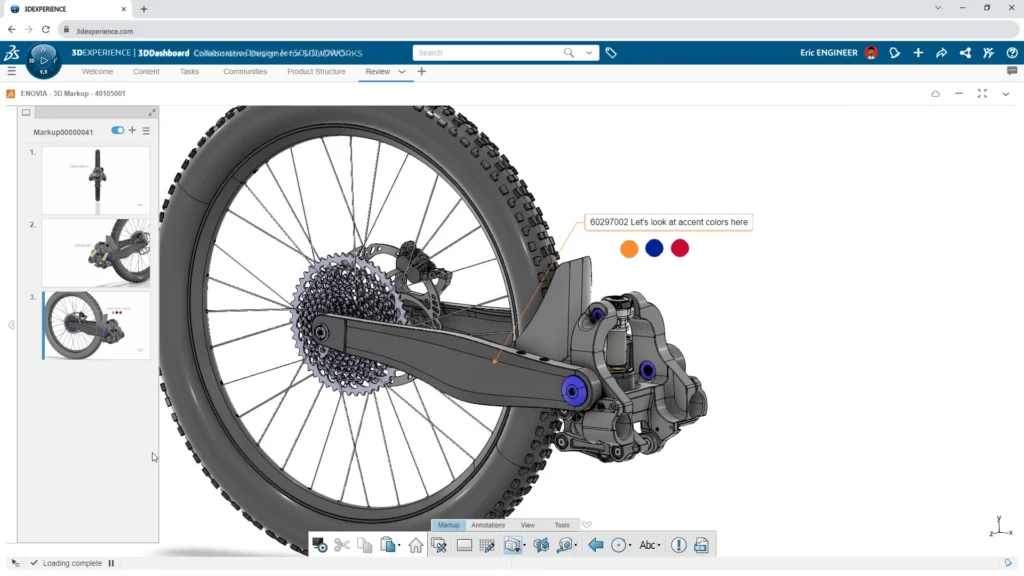
On the 3DEXPERIENCE platform, everyone reviews the same product definition. The manager can see the latest design, markups, comments, simulation results, and manufacturing feedback in context.
A concern appears around one component. Simulation shows a stress concentration. Manufacturing warns that one design option may affect tooling. The team compares alternatives and agrees on the best path.
The manager makes a decision, assigns follow-up actions, and captures everything directly in the platform. The review becomes more than a discussion; it becomes a connected decision point.
4. Responding to an Urgent Issue
Just after the design review, an urgent notification arrives.
A test result has revealed unexpected vibration in a product variant close to release. This could affect timing, validation, and customer commitments.
In a disconnected process, the manager would need to ask many questions: Which version was tested? Which component is affected? Who owns it? Has the simulation been reviewed? Will manufacturing be impacted?
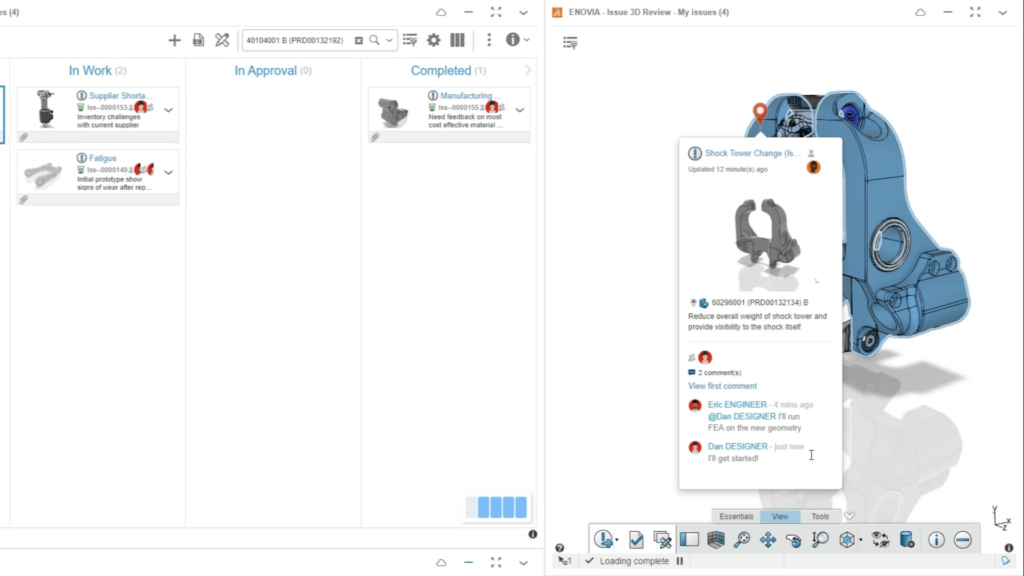
On the platform, the issue is already linked to the product structure, the affected component, the responsible team members, comments, documents, and related tasks.
The manager quickly assigns actions. The designer reviews the geometry. The simulation engineer validates the vibration scenario. Manufacturing checks tooling impact. Quality monitors documentation requirements.
The issue is no longer buried in an email thread. It has ownership, visibility, context, and urgency.
This is the difference between firefighting and controlled response.
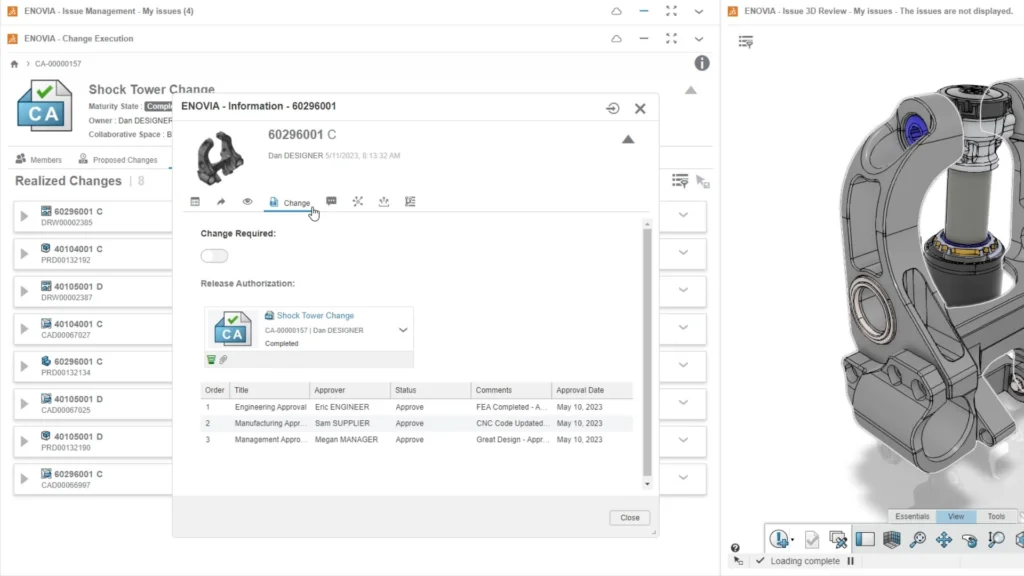
5. Change Management: Moving Fast Without Losing Control
The urgent issue leads to a possible design change.
The proposed modification looks promising, but the manager knows that even a small change can affect cost, tooling, documentation, validation, suppliers, and schedule.
Using the platform, the manager reviews the change request with full context. The affected component, previous revision, proposed update, related comments, simulation feedback, and manufacturing concerns are all connected.
The manager can assess the impact clearly:
- Does it need new validation?
- Does it affect the bill of materials?
- Will suppliers be impacted?
- Can the schedule still be protected?
The change is approved with conditions: simulation must confirm the update, manufacturing must complete a producibility check, and documentation must be revised before release.
This is not bureaucracy. It is controlled decision-making.
The team can move quickly while maintaining traceability and confidence.
6. Staying Informed Without Attending Every Meeting
As the day continues, the manager moves from one commitment to another. Meanwhile, the team keeps working.
The designer updates the model. Simulation posts preliminary results. Manufacturing adds feedback. Quality asks for clarification.
The manager cannot attend every discussion — and should not need to.
Through dashboards, notifications, collaborative spaces, and task updates, the platform keeps the manager informed without becoming a bottleneck. They can scan activity, comment when needed, approve when appropriate, and let the team continue.
This supports a healthier leadership style: less micromanagement, more visibility.
The manager stays informed while the team stays empowered.
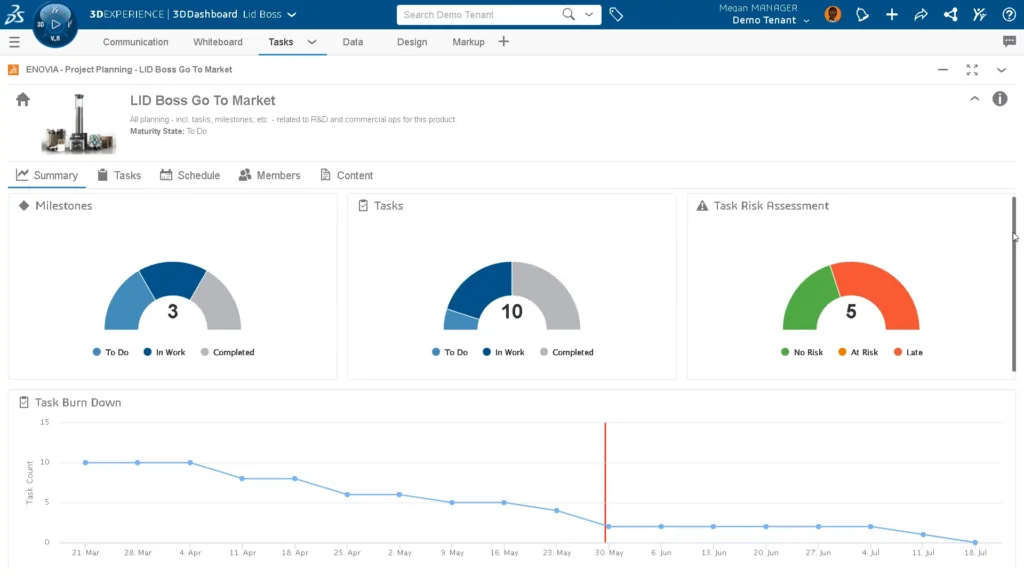
7. Executive Update: Connecting Engineering Work to Business Priorities
Later in the day, the manager prepares for an executive update.
Executives do not need every technical detail. They need to know whether the program is healthy whether milestones can still be met.
The manager uses the platform to review project status, open changes, issue severity, maturity, and upcoming milestones.
Now the update is clear:
“We found a vibration concern during validation. The affected component has been reviewed. A design change is approved for validation. Simulation and manufacturing checks are in progress. There is a possible schedule risk, but the team has a recovery plan.”
This is far stronger than saying, “The team is looking into it.”
The manager can communicate with confidence because the information is current, connected, and traceable.
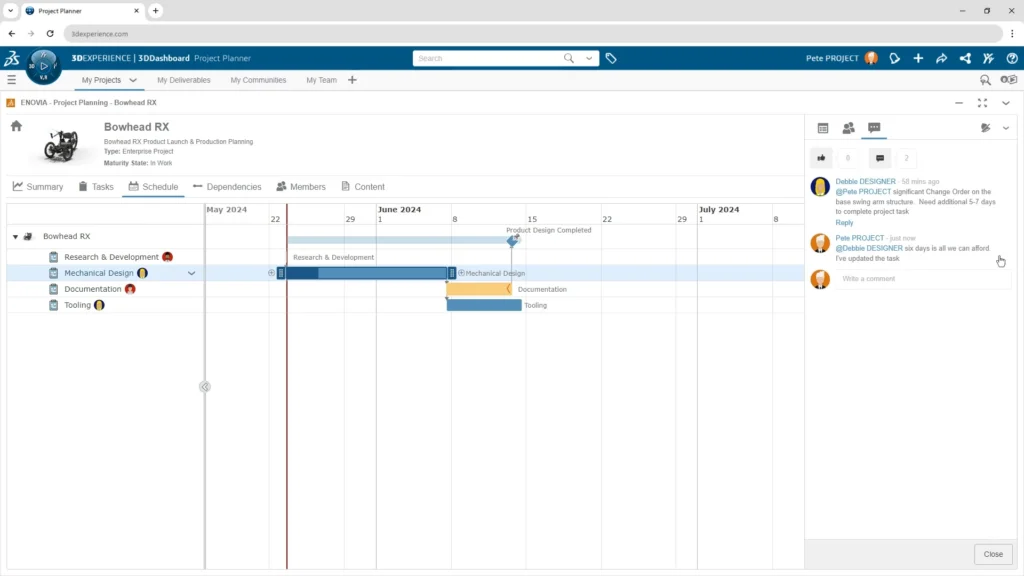
8. Business Travel: Staying Connected from Anywhere
By late afternoon, the manager leaves for the airport.
Tomorrow includes a supplier visit and a customer meeting. In the past, travel might have delayed decisions. Approvals would wait. The team might pause until the manager returned.
Now, while waiting at the airport, the manager opens the platform again.
Simulation has posted preliminary validation results. Manufacturing has confirmed that the change will not significantly affect tooling. A change approval is waiting.
The manager reviews the connected information, adds a comment, approves the next step, and keeps the team moving before boarding the flight.
The office travels with the manager.
Migma Packtron highlighted this same advantage, noting that the platform empowers team members to collaborate from anywhere, at any time, and on any device. (SOLIDWORKS)
This does not mean working every minute. It means having the right access, at the right moment, with the right context.
9. End of Day: Decisions Captured, Team Aligned
At the end of the day, the manager checks the dashboard one final time.
The urgent issue has been assigned. The design review decisions are captured. The change request is moving forward. Simulation, manufacturing, and quality have clear actions. The project risk is visible. The executive update is complete.
The day was busy, but it was not chaotic.
The manager did not spend the day searching for information. They made decisions. They did not chase every team member for status. They guided priorities. They did not lose control when an urgent issue appeared. They turned it into a managed process.
This is what connected leadership looks like.
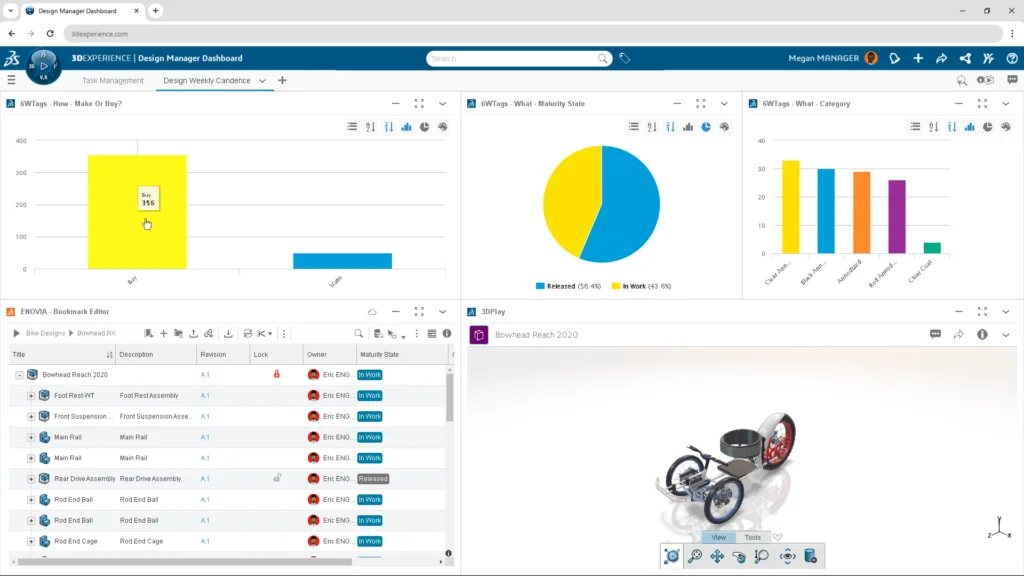
Conclusion: The Connected Manager
Modern managers are expected to lead distributed teams, manage complex products, respond to urgent issues, control changes, and make fast decisions with confidence.
That is difficult when information is disconnected.
The 3DEXPERIENCE platform provides managers with a connected environment where people, product data, tasks, issues, changes, dashboards, and decisions come together.
The result is:
- A dashboard becomes the morning pulse of the business.
- A design review becomes a connected decision point.
- An urgent issue becomes a traceable action plan.
- A change request becomes a controlled business decision.
- Business travel no longer means being disconnected.
The platform does not replace the manager’s judgment. It strengthens it.
It gives managers the visibility to lead, the context to decide, and the confidence to keep teams moving — from anywhere.